


Introduction
If you know your zodiac sign, you may already know its place in the familiar sequence of Aries, Taurus, Gemini, and the other 12 signs. But what sign comes next after yours? The answer is simple once you understand how the zodiac cycle works: every sign is followed by another sign in a fixed order, and after Pisces, the cycle begins again with Aries.
This guide explains what comes after each zodiac sign, including the commonly used Western tropical date ranges, symbols, elements, and traditional themes. Whether you’re learning astrology for the first time, checking zodiac compatibility, or simply curious about the sign that follows your own, this complete guide provides an easy reference. We’ll also explain the difference between zodiac order, elements, modalities, and the meaning of the repeating cycle.
Note: This article follows the Western tropical zodiac. Personality descriptions and symbolic interpretations are traditional astrological concepts and are not scientifically established personality measurements.
The Complete Zodiac Order
The 12 zodiac signs always follow the same sequence:
Aries → Taurus → Gemini → Cancer → Leo → Virgo → Libra → Scorpio → Sagittarius → Capricorn → Aquarius → Pisces → Aries
Because the zodiac is traditionally represented as a cycle, Pisces does not represent the final point with no continuation. Instead, Pisces is followed by Aries, beginning another complete cycle.
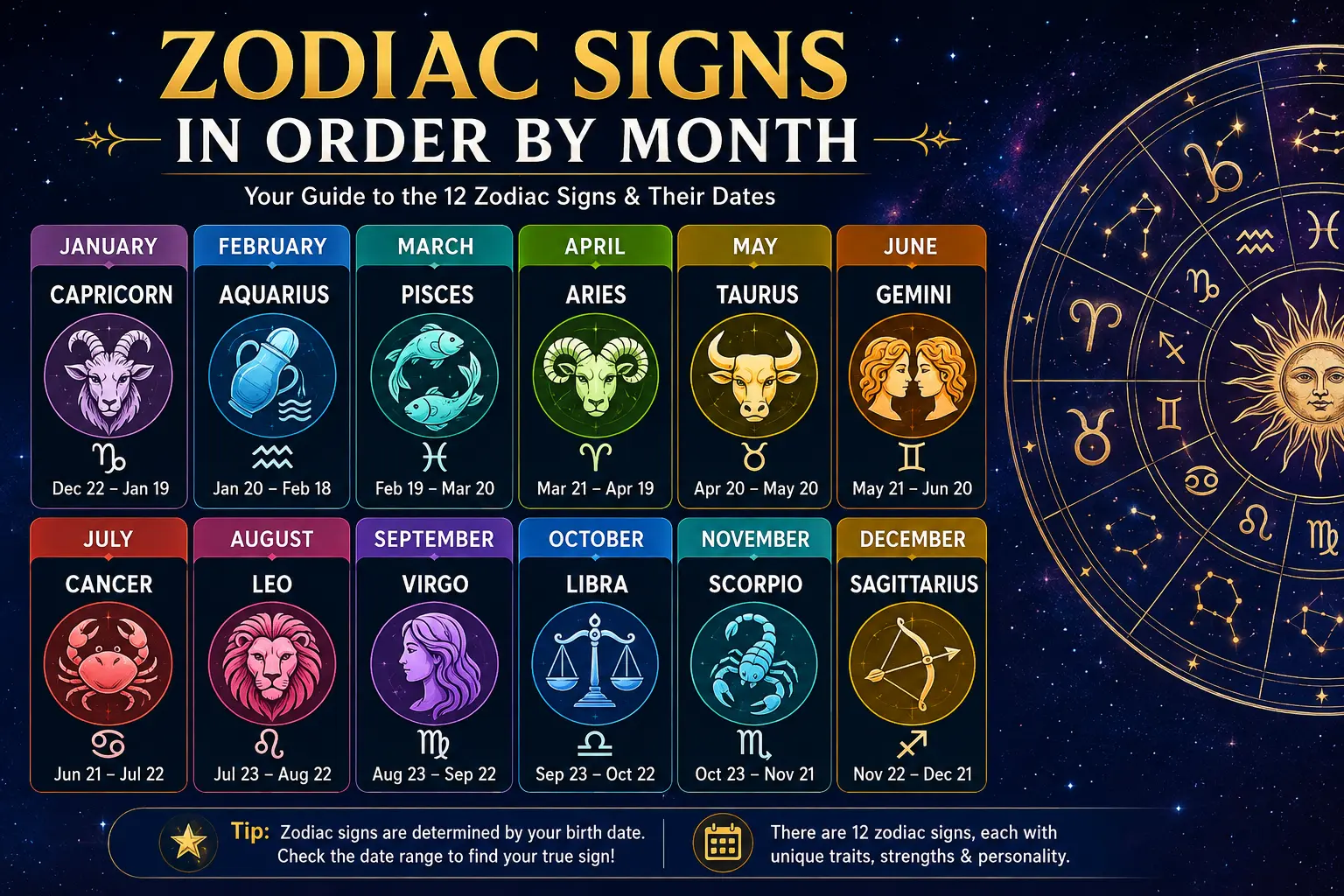
| Order | Zodiac Sign | Common Date Range | Symbol | Element |
| 1 | Aries | March 21 – April 19 | Ram ♈ | Fire |
| 2 | Taurus | April 20 – May 20 | Bull ♉ | Earth |
| 3 | Gemini | May 21 – June 20 | Twins ♊ | Air |
| 4 | Cancer | June 21 – July 22 | Crab ♋ | Water |
| 5 | Leo | July 23 – August 22 | Lion ♌ | Fire |
| 6 | Virgo | August 23 – September 22 | Maiden ♍ | Earth |
| 7 | Libra | September 23 – October 22 | Scales ♎ | Air |
| 8 | Scorpio | October 23 – November 21 | Scorpion ♏ | Water |
| 9 | Sagittarius | November 22 – December 21 | Archer ♐ | Fire |
| 10 | Capricorn | December 22 – January 19 | Sea-Goat ♑ | Earth |
| 11 | Aquarius | January 20 – February 18 | Water-Bearer ♒ | Air |
| 12 | Pisces | February 19 – March 20 | Fish ♓ | Water |
These are commonly published date ranges for the Western tropical zodiac. Exact Sun-sign transitions can vary by year and time zone, so people born close to a boundary may need their exact birth time and location for a precise calculation.
What Comes After Aries?
Aries → Taurus
If your zodiac sign is Aries, the sign that comes after it is Taurus.
Aries is traditionally associated with initiative, action, independence, and enthusiasm. Taurus follows it and is traditionally linked with stability, patience, practicality, and persistence.
- Aries: Fire sign
- Taurus: Earth sign
- Traditional shift: Action → stability
This transition illustrates one of the recurring patterns in the zodiac: the signs move through different elements and qualities rather than repeating the same combination consecutively.
What Comes After Taurus?
Taurus → Gemini
After Taurus comes Gemini.
Taurus is traditionally associated with steadiness and practical concerns, while Gemini is associated with curiosity, communication, learning, and adaptability.
- Taurus: Earth sign
- Gemini: Air sign
- Traditional shift: Stability → curiosity
Gemini introduces a more communicative and intellectually oriented symbolism into the zodiac sequence.
What Comes After Gemini?
Gemini → Cancer
The sign after Gemini is Cancer.
Gemini is traditionally associated with communication and intellectual curiosity. Cancer shifts toward Water-sign themes such as emotional connection, nurturing, protection, and home.
- Gemini: Air sign
- Cancer: Water sign
- Traditional shift: Ideas → emotions
This is the third transition in the zodiac cycle and continues the movement through different elements.
What Comes After Cancer?
Cancer → Leo
After Cancer comes Leo.
Cancer is traditionally connected with emotional sensitivity and nurturing, while Leo is associated with creativity, confidence, warmth, and self-expression.
- Cancer: Water sign
- Leo: Fire sign
- Traditional shift: Emotional connection → expression
Leo also begins the second quarter of the zodiac sequence.
What Comes After Leo?
Leo → Virgo
The sign following Leo is Virgo.
Leo is traditionally associated with creative expression and confidence. Virgo brings Earth-sign themes such as practicality, organization, analysis, and attention to detail.
- Leo: Fire sign
- Virgo: Earth sign
- Traditional shift: Expression → refinement
This pairing demonstrates that neighboring zodiac signs can have very different traditional characteristics.
What Comes After Virgo?
Virgo → Libra
After Virgo comes Libra.
Virgo is traditionally connected with organization, analysis, and practical improvement. Libra shifts toward themes involving balance, relationships, cooperation, diplomacy, and harmony.
- Virgo: Earth sign
- Libra: Air sign
- Traditional shift: Analysis → balance
Libra is also distinctive because its symbol, the Scales, is an object rather than an animal or human figure.
What Comes After Libra?
Libra → Scorpio
The sign after Libra is Scorpio.
Libra is traditionally associated with balance, cooperation, and relationships. Scorpio introduces Water-sign themes of emotional depth, focus, determination, intensity, and transformation.
- Libra: Air sign
- Scorpio: Water sign
- Traditional shift: Cooperation → depth
Scorpio occupies the eighth position in the zodiac cycle.
What Comes After Scorpio?
Scorpio → Sagittarius
After Scorpio comes Sagittarius.
Scorpio is traditionally associated with depth and intensity, while Sagittarius is connected with exploration, adventure, learning, optimism, and broadening one’s horizons.
- Scorpio: Water sign
- Sagittarius: Fire sign
- Traditional shift: Depth → exploration
Sagittarius is represented by the Archer, traditionally symbolizing the pursuit of distant goals and broader experiences.
What Comes After Sagittarius?
Sagittarius → Capricorn
The zodiac sign that follows Sagittarius is Capricorn.
Sagittarius is traditionally associated with exploration and freedom, while Capricorn emphasizes discipline, responsibility, structure, persistence, and long-term goals.
- Sagittarius: Fire sign
- Capricorn: Earth sign
- Traditional shift: Exploration → structure
Capricorn is the tenth sign in the traditional zodiac sequence.
What Comes After Capricorn?
Capricorn → Aquarius
After Capricorn comes Aquarius.
Capricorn is traditionally linked with structure and long-term achievement. Aquarius shifts toward traditional themes of independence, originality, innovation, and unconventional thinking.
- Capricorn: Earth sign
- Aquarius: Air sign
- Traditional shift: Structure → ideas
One common misconception is that Aquarius is a Water sign because its symbol is the Water-Bearer. In Western astrology, however, Aquarius is traditionally classified as an Air sign.
What Comes After Aquarius?
Aquarius → Pisces
The sign following Aquarius is Pisces.
Aquarius is traditionally associated with independent ideas and innovation. Pisces moves into Water-sign themes involving imagination, sensitivity, compassion, intuition, and emotional depth.
- Aquarius: Air sign
- Pisces: Water sign
- Traditional shift: Ideas → imagination
Pisces is the 12th and final sign in the traditional sequence.
But the zodiac does not stop there.
What Comes After Pisces?
Pisces → Aries
After Pisces, the cycle returns to Aries.
This is an important part of understanding the zodiac. Pisces is the 12th sign, but it isn’t a permanent endpoint. The traditional sequence loops back to the first sign, Aries.
Pisces → Aries → Taurus → Gemini → …
This creates the complete repeating zodiac cycle.
In symbolic terms, Aries is associated with beginnings and initiative, while Pisces traditionally represents completion, reflection, and transition. The movement from Pisces back to Aries can therefore be viewed within astrology as a symbolic transition from one cycle into another.
Zodiac Signs in Order: Quick Reference
If you simply want to know what sign comes next, use this list:
- Aries → Taurus
- Taurus → Gemini
- Gemini → Cancer
- Cancer → Leo
- Leo → Virgo
- Virgo → Libra
- Libra → Scorpio
- Scorpio → Sagittarius
- Sagittarius → Capricorn
- Capricorn → Aquarius
- Aquarius → Pisces
- Pisces → Aries
The last pairing is the one people sometimes overlook. Aries follows Pisces, because the zodiac is traditionally a cycle rather than a straight line.
Zodiac Signs and Their Elements
The sequence also follows a repeating elemental pattern.
There are four traditional elements:
- Fire
- Earth
- Air
- Water
The zodiac signs are grouped as follows:
| Element | Signs |
| Fire | Aries, Leo, Sagittarius |
| Earth | Taurus, Virgo, Capricorn |
| Air | Gemini, Libra, Aquarius |
| Water | Cancer, Scorpio, Pisces |
Interestingly, the first three signs follow a clear pattern:
Aries (Fire) → Taurus (Earth) → Gemini (Air) → Cancer (Water)
The same four-element sequence then repeats:
Leo (Fire) → Virgo (Earth) → Libra (Air) → Scorpio (Water)
And again:
Sagittarius (Fire) → Capricorn (Earth) → Aquarius (Air) → Pisces (Water)
This creates a useful pattern for remembering the zodiac order.
Zodiac Signs by Modality
Another way to understand the zodiac sequence is through modalities, or qualities.
There are three:
- Cardinal
- Fixed
- Mutable
| Modality | Zodiac Signs | Traditional Association |
| Cardinal | Aries, Cancer, Libra, Capricorn | Initiation |
| Fixed | Taurus, Leo, Scorpio, Aquarius | Stability |
| Mutable | Gemini, Virgo, Sagittarius, Pisces | Adaptation |
Each four-sign section contains one sign from each modality pattern.
For example:
- Aries — Cardinal
- Taurus — Fixed
- Gemini — Mutable
- Cancer — Cardinal
Then the sequence begins again with Leo.

Why Does One Zodiac Sign Come After Another?
In Western astrology, the zodiac is traditionally divided into 12 equal signs arranged around the ecliptic. The signs have a fixed sequence that begins with Aries in the tropical zodiac framework.
The order itself does not change.
What can change is the exact calendar date and time when the Sun moves from one sign to the next. This is why different astrology websites may occasionally display slightly different boundary dates.
For someone born well within a sign’s commonly published date range, this usually isn’t an issue. For someone born near a transition, the exact time and location can matter.
What If Your Birthday Is on a Zodiac Cusp?
A person born close to the transition between two zodiac signs is often described as being on the cusp.
For example, birthdays around:
- Aries/Taurus
- Taurus/Gemini
- Gemini/Cancer
- Cancer/Leo
- Leo/Virgo
- Virgo/Libra
- Libra/Scorpio
- Scorpio/Sagittarius
- Sagittarius/Capricorn
- Capricorn/Aquarius
- Aquarius/Pisces
- Pisces/Aries
may require more precise information.
How to determine your sign accurately
If you’re near a boundary:
- Find your exact birth date.
- Find your exact birth time.
- Identify your birthplace.
- Use a birth-chart calculation based on the Western tropical zodiac.
Rather than assuming you automatically have two Sun signs, check where the Sun was actually positioned at your birth.
Does the Next Zodiac Sign Affect Compatibility?
Not necessarily.
The fact that two signs are next to each other in the zodiac does not automatically mean they are compatible or incompatible.
Astrological compatibility can involve several factors, including:
- Sun signs
- Moon signs
- Ascendants
- Elements
- Modalities
- Planetary positions
- Aspects between planets
For example, Aries and Taurus are neighboring signs, but their traditional elemental classifications differ: Aries is Fire, while Taurus is Earth.
Therefore, zodiac order alone isn’t enough to determine a complete compatibility picture.
Zodiac Cycle vs. Birth-Date Calendar
It’s useful to distinguish between the order of the zodiac and the calendar dates associated with the signs.
The order remains:
Aries → Taurus → Gemini → Cancer → Leo → Virgo → Libra → Scorpio → Sagittarius → Capricorn → Aquarius → Pisces
But the commonly listed date ranges cross from one calendar month into another.
For example:
- Aries: March–April
- Taurus: April–May
- Gemini: May–June
- Cancer: June–July
- Leo: July–August
- Virgo: August–September
- Libra: September–October
- Scorpio: October–November
- Sagittarius: November–December
- Capricorn: December–January
- Aquarius: January–February
- Pisces: February–March
This is why each zodiac sign can be understood as both part of a fixed sequence and a seasonal calendar framework.
Western Zodiac and Vedic Astrology: Why the Order Can Look Different
Readers in India may encounter different zodiac information when comparing Western astrology with Vedic astrology.
The Western system commonly used for Sun-sign horoscopes uses the tropical zodiac, while Vedic astrology generally uses a sidereal zodiac.
The two systems use different reference frameworks, which can result in different Sun-sign assignments for the same birth date.
If you’re checking your zodiac sign online, always determine whether the source is using Western tropical astrology or Vedic/sidereal astrology before comparing the result.
Is the Zodiac Cycle Scientifically Proven?
The zodiac sequence itself is a traditional framework used in astrology and has historical and cultural significance.
However, traditional astrological claims about personality, behavior, or future events are not established scientific methods for predicting personality or life outcomes.
For that reason, zodiac descriptions are best understood as part of an astrological tradition. They can be interesting for cultural exploration, entertainment, and personal reflection without being presented as scientifically proven facts.
Frequently Asked Questions
What comes after Aries in the zodiac?
Taurus comes after Aries in the Western zodiac sequence. Aries is the first sign, followed by Taurus, Gemini, Cancer, Leo, Virgo, Libra, Scorpio, Sagittarius, Capricorn, Aquarius, and Pisces.
What comes after Pisces?
Aries comes after Pisces, completing the repeating zodiac cycle. Pisces is the 12th sign, and the sequence loops back to Aries rather than ending permanently.
What is the order of the 12 zodiac signs?
The zodiac signs in order are Aries, Taurus, Gemini, Cancer, Leo, Virgo, Libra, Scorpio, Sagittarius, Capricorn, Aquarius, and Pisces. After Pisces, the sequence starts again with Aries.
Which zodiac sign comes after Scorpio?
Sagittarius comes after Scorpio. Scorpio is traditionally a Water sign associated with intensity and depth, while Sagittarius is a Fire sign traditionally associated with exploration and adventure.
Does the zodiac order change?
No, the traditional zodiac order does not change. The 12 signs remain in the same sequence, although the exact date and time of the Sun’s transition between signs can vary by year and location.
Are neighboring zodiac signs compatible?
Being neighboring zodiac signs does not automatically determine compatibility. Astrological compatibility is traditionally assessed using several factors, including elements, modalities, planetary positions, and other parts of a birth chart.
Conclusion
Knowing what comes after each zodiac sign is one of the easiest ways to understand the structure of the Western zodiac.
The complete cycle is:
Aries → Taurus → Gemini → Cancer → Leo → Virgo → Libra → Scorpio → Sagittarius → Capricorn → Aquarius → Pisces → Aries
Every sign has a specific position, element, modality, symbol, and collection of traditional astrological themes. Once you memorize the sequence, you can quickly identify the sign before or after any zodiac sign.
The most important point to remember is that Pisces is not the permanent end of the zodiac. It leads directly back to Aries, creating the repeating cycle that connects all 12 signs.
If you’re exploring astrology further, learning about zodiac elements, modalities, symbols, compatibility, Moon signs, and Ascendants can provide a broader understanding of how the traditional system is structured.