


Open a fitness app and you might see a streak. Finish a lesson and a badge appears. Buy something from a loyalty program and your points move closer to the next reward. Even workplace software increasingly uses progress bars, challenges and achievement systems.
None of these experiences is necessarily a game. Yet they all borrow from games. That is gamification, and it has quietly become one of the most common ways digital products encourage people to keep participating.
Quick Takeaways
- Gamification applies game-inspired mechanics to non-game activities.
- Common examples include points, badges, levels, streaks, challenges, rewards and leaderboards.
- Companies use it to encourage engagement, repeat activity, learning and customer loyalty.
- Gamification can work particularly well when users need feedback or motivation to complete a long-term goal.
- More game mechanics do not automatically mean a better experience.
- The best systems connect rewards and feedback to a genuinely useful user action.
What Is Gamification?
Gamification is the use of game elements in a non-game environment to encourage participation, motivation, learning, or another desired behavior.
Think about a language-learning app. Learning vocabulary is not inherently a game. But when the app gives you experience points, tracks your daily streak, lets you complete challenges and shows your progress toward the next level, the learning experience starts borrowing familiar game mechanics.
The underlying activity remains learning.
The interface simply gives you more feedback about what you are doing.
That distinction is important because gamification is sometimes misunderstood as “turning everything into a game.” It isn’t. A bank app does not become a video game because it has reward points. A fitness platform does not become a game because it gives you an achievement badge.
Gamification is really about using selected game-like mechanics to influence how people interact with an experience.
Why Does Gamification Work So Well?
The appeal becomes easier to understand when you look at what happens after a user performs an action.
Suppose you complete a 20-minute workout.
Without gamification, the app might simply record that the workout happened.
With gamification, you could see:
Workout completed → 20 points earned → weekly goal 80% complete → 3-day streak maintained
The exercise itself has not changed. What has changed is the feedback surrounding it.
That feedback can make progress more visible.
Progress Gives People a Reason to Continue
Large goals can feel abstract.
“Learn Spanish” is a huge objective.
“Complete today’s five-minute lesson” feels manageable.
A progress bar, daily target or series of small challenges can break the larger objective into smaller steps. This is one reason gamification appears so frequently in education, fitness and productivity tools.
Rewards Create Immediate Feedback
Many worthwhile activities have delayed benefits.
Exercise may improve health over time. Studying may help with an exam weeks later. Saving money may benefit you months from now.
Gamification can introduce a smaller, immediate feedback loop.
You complete something today and immediately see progress.
That does not replace the real benefit, but it can make the path toward it easier to follow.
Competition Can Add Another Layer
Leaderboards and rankings introduce social comparison.
For some people, seeing that they are number 12 can be enough motivation to aim for number 10.
For others, it can have the opposite effect.
That is why effective gamification should not assume that every user wants competition. A personal-best system—“beat your previous score”—can be more appropriate than publicly ranking everyone.
Gamification Examples You Probably Use Every Day
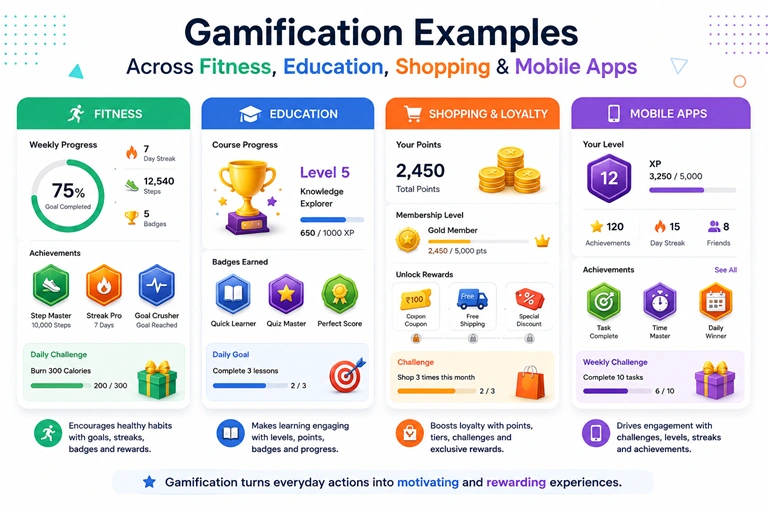
Gamification is no longer limited to specialist apps. It appears in ordinary digital experiences.
Fitness and Health Apps
Fitness platforms commonly use:
- Daily goals
- Streaks
- Achievement badges
- Weekly challenges
- Progress charts
- Personal records
- Milestones
A user may start with the simple goal of walking more. Over time, the app can turn that behavior into a series of smaller targets.
The important part is not the badge itself. The badge is useful because it gives the user a visible marker of achievement.
Language-Learning Apps
Language learning is an especially obvious use case.
Users may receive points for lessons, maintain daily streaks, complete challenges, move through levels and compare results with other learners.
Why does this fit the activity?
Because language acquisition requires repetition. A system that encourages users to return regularly is addressing a real behavioral challenge.
Shopping and Loyalty Programs
Retailers use gamification through loyalty points, membership levels, special challenges and rewards.
A customer might earn points after every purchase and eventually receive a discount or another benefit.
Some programs add tiers:
Basic → Silver → Gold → Premium
The tier system creates a visible sense of progression while giving customers a reason to continue participating.
Online Education
Educational platforms can use badges, certificates, progress indicators, quizzes and completion milestones.
Imagine a 30-hour online course.
“30 hours remaining” sounds daunting.
“12 of 15 modules completed” feels different.
That small change in presentation can make progress easier to understand.
Workplace Software
Gamification also appears in employee training, sales dashboards and productivity platforms.
A training program might award certificates for completed modules. A sales team might use a leaderboard. An onboarding platform might divide a complex process into a series of tasks.
But workplace gamification needs careful design. Competition can motivate one group while creating unnecessary pressure for another.
What Are the Main Gamification Mechanics?
There is no universal formula. Different products need different mechanics.
Points
Points provide numerical feedback.
They are useful when the system needs a simple way to represent accumulated activity.
Badges
Badges visually recognize an achievement.
They can be particularly effective when users want to collect milestones or demonstrate expertise.
Streaks
Streaks encourage repeated behavior.
They are common in learning and fitness because consistency matters in both areas.
Levels
Levels create a sense of progression.
A user might move from beginner to intermediate to advanced, or simply progress from Level 1 to Level 20.
Challenges
Challenges give users a defined objective.
Instead of saying “use the app more,” a system might say, “Complete three lessons this week.”
That is much easier to understand.
Leaderboards
Leaderboards add competition by ranking participants.
They can work well when the audience is comfortable with competition, but they should not automatically be treated as a universal motivator.
Progress Bars
Progress bars are among the simplest mechanics.
They answer a basic question:
How much is left?
Sometimes that is all the motivation a user needs.
Gamification in Business: Why Companies Use It
Businesses generally do not add gamification simply because games are entertaining.
There is usually a measurable business objective behind it.
A company might want customers to return more often, complete onboarding, participate in a loyalty program, finish training or interact with a particular feature.
Customer Engagement
A reward system can give customers an additional reason to interact with a service.
For example, a retailer could reward customers for purchases, reviews or referrals.
The trick is making the reward system easy to understand.
If customers cannot tell how many points they have, what those points are worth, or how to redeem them, the mechanic creates friction instead of engagement.
Customer Retention
Gamification can also encourage repeat behavior.
A daily challenge, loyalty milestone or personalized progress target can create another reason to return.
That does not mean every returning visitor is valuable, though. Businesses should measure meaningful outcomes rather than simply counting clicks.
Employee Training
Training can be difficult to maintain when employees have busy schedules.
Breaking training into smaller missions, tracking completion and recognizing achievements can make progress more visible.
The content still needs to be useful. Gamification should support the training rather than distract from it.
What Are the Benefits—and Risks—of Gamification?
When designed around a real user need, gamification can offer several benefits:
- Greater engagement
- More visible progress
- Increased participation
- Better consistency
- Stronger learning habits
- More customer interaction
- Improved completion rates
- Greater sense of achievement
But there is another side to the story.
When Gamification Goes Wrong
Imagine an app that sends constant notifications because you have a streak.
At first, that might be motivating.
After a while, it can become annoying.
The same thing can happen with excessive badges, meaningless points, aggressive leaderboards or rewards that encourage users to perform actions without understanding why those actions matter.
A badly designed system can make an otherwise simple product feel like a chore.
There is also a broader question worth asking: Are people participating because the activity is valuable, or simply because the system is pushing them toward another reward?
That distinction matters.
Good gamification strengthens the underlying experience. Bad gamification distracts from it.
How to Build a Better Gamification Strategy
If you are designing a product, course, website or business program, start with the behavior—not the badge.
1. Define the Goal
What should users actually do?
Complete lessons? Exercise regularly? Finish onboarding? Make repeat purchases?
Be specific.
2. Understand the Audience
Different people respond to different motivations.
Some enjoy competition. Others prefer private progress. Some care about rewards, while others simply want clear feedback.
3. Select the Simplest Useful Mechanic
Do you really need a leaderboard?
Maybe a progress bar is enough.
Do users need ten badges?
Perhaps three meaningful milestones would communicate achievement better.
Simple systems are often easier to understand and maintain.
4. Give Users Clear Feedback
Users should immediately understand what happened after an action.
If they completed a challenge, show that it was completed.
If they earned points, make the points visible.
If they moved closer to a goal, show the progress.
5. Measure Real Outcomes
Track metrics connected to the original goal.
Depending on the product, that might include:
- Completion rate
- Retention
- Repeat usage
- Conversion
- Course completion
- Task completion
- Reward redemption
- Customer activity
A feature that generates thousands of clicks but fails to improve the actual business or user objective may not be successful.
Is Gamification the Future of Digital Experiences?
Gamification is likely to remain relevant because digital products increasingly need to guide users through repeated actions.
But the future is unlikely to be about simply adding more badges.
Personalization could become much more important.
Imagine two users opening the same learning platform. One prefers competition. The other responds better to private goals. Instead of giving both users the same leaderboard, the system could adjust the experience based on their behavior and preferences.
AI could make these experiences even more adaptive.
That does not mean AI automatically makes gamification better. The underlying principles remain the same: understand the user, define the goal, provide useful feedback and avoid unnecessary complexity.
Google’s 2026 guidance on generative AI search similarly emphasizes providing unique, useful content rather than producing generic material at scale. Google has also specifically expanded its guidance around image and video content for generative search experiences.
For publishers covering gamification, that creates an opportunity: don’t just define the term. Explain why it works, where it fails, how businesses use it, and what users should watch for.
That is much more useful than another generic list of definitions.
Gamification vs. Game-Based Learning
These concepts sound similar but are different.
Gamification adds game elements to an existing activity.
For example, an online course awards points and badges for completing lessons.
Game-based learning uses an actual game as part of the learning process.
For example, students might learn mathematics by solving problems inside a purpose-built educational game.
In short:
Gamification = game mechanics added to an activity.
Game-based learning = learning through a game.
The distinction becomes particularly useful when designing educational products.
Frequently Asked Questions
What is gamification in simple terms?
Gamification means adding game-inspired elements such as points, badges, challenges, levels or rewards to a non-game activity to encourage participation, show progress or make the experience more engaging.
What are some examples of gamification?
Common examples include fitness streaks, loyalty points, language-learning levels, achievement badges, progress bars, online-course milestones, workplace challenges and customer reward programs.
Why do companies use gamification?
Companies use gamification to encourage useful behaviors such as repeat purchases, course completion, employee training, product adoption, customer participation and consistent engagement.
Is gamification good or bad?
Gamification can be effective when it supports a meaningful goal and provides useful feedback. Poorly designed gamification can become distracting, repetitive or overly focused on rewards and competition.
Final Takeaway
Gamification works because it makes progress visible.
A streak tells you that you have been consistent. A badge shows that you achieved something. A progress bar tells you how far you have come. A challenge gives you a concrete next step.
The technology behind these features may become more sophisticated, especially as personalization and AI develop. But the fundamental principle is surprisingly simple: give people clear goals, useful feedback and a reason to keep moving forward.
That is why gamification has moved far beyond games—and why you are likely to encounter it more often, not less, in the years ahead.