

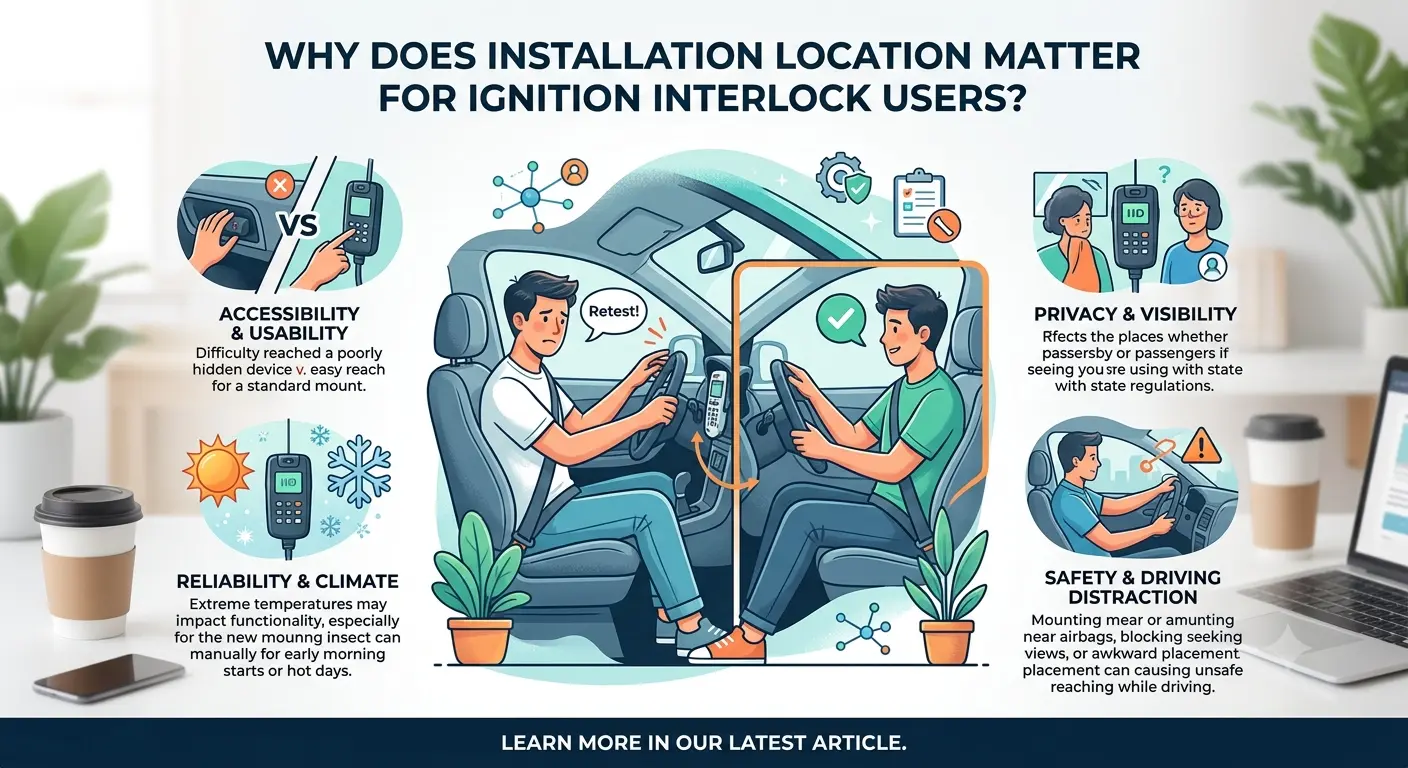

Typically installation of an interlock is treated as a single event and included in a license reinstatement package. However, in most jurisdictions the install site is designated as the client’s recurring service location for the duration of the monitoring period (up to 1 year or more). This means that the location where you install an interlock for a client will be the site where they return for service on a schedule of every 30-60 days for a year or more.
The calibration calendar drives everything else
One monitoring period is made up of many appointments scheduled on a set time interval. Each appointment includes a ‘window of mercy’ of 5-7 days, and after that the device locks out permanently. The monitoring period can last for as long as 18 months and include as many as 9 service visits with the client (centered around a 60 day interval).
Missed calibrations lead to program extensions, in most cases not due to neglect but to an unexpected event (e.g., the client has to be somewhere 45 minutes away and cannot reschedule within the lockout window).
What a service visit actually costs the client
Your client’s time is more valuable than you think. All the cost in the world does not help if your client’s service appointment is filled or they are forced to reschedule at the last minute.
- Round-trip travel time, which for a distant shop can exceed the appointment itself
- Time in the bay, generally 20 to 45 minutes depending on data download and recalibration
- Lost wages or paid time off, particularly where the shop keeps weekday-only hours
- Fuel and, in dense urban areas, parking
- Childcare or dependent coverage during the trip
A 4 hour disruption every 2 months will cause enough deficiency to start having clients miss appointments. However, a 40 minute disruption will not cause enough deficiency to have clients miss appointments.
Comparing location profiles against real constraints
Don’t assume that every convenient location is acceptable. Sure, proximity is a key factor but also look at hours of business, availability for appointments and how a 24 hour lockout could be handled outside of normal business hours.
| Location profile | Typical strength | Typical weakness | Best suited to |
| Dedicated interlock center | Trained technicians, walk-in capacity, full parts inventory | Often concentrated in metro areas only | Clients within a 20-minute urban drive |
| Independent auto shop with certification | Wide geographic spread, familiar local business | Limited appointment slots, fewer trained staff | Rural and suburban clients |
| Mobile service unit | Comes to the client, no travel burden | Restricted coverage zones, advance booking required | Clients with mobility limits or shift work |
| Dealership-affiliated site | Extended weekday and Saturday hours | Higher labor rates, longer wait times | Clients who need weekend service |
Matching the profile to the client’s week
Ask two simple questions to determine if a particular provider is the best fit for your client, 1) What are your client’s available hours for service? 2) How far is your client willing to travel for service? A rideshare driver with irregular work hours may need a provider with walk-in capacity, whereas a parent with a child in school may need a provider with several locations in close geographic proximity. Service quality may suffer slightly at a location that is closer to a client’s home, but that trade-off still beats a client who cannot reach a distant shop, so it is worth mapping the certified Virginia ignition interlock installation locations against the client’s weekly routine before committing to one.
Accessibility as a compliance factor, not a courtesy
Clients will need to make calibrations regardless of transport issues and, as noted previously, the lack of access to a certified, interlock servicing center can result in the same type of violation as missing a scheduled appointment.
Yes, many interlock installation sites are located in industrial areas that do not have bus service and lack sidewalks. Sites such as these can work for clients who have cars but will fail the client who needs to lock out his or her vehicle and cannot get to a certified site to have it opened by a technician.
Emergency and lockout response
There are instances when devices fail, batteries die, handsets are damaged, or even have false positives that result in a lockout. These situations require a technician to clear the lockout code for the client and can result in long periods of time where a driver is unable to use their vehicle. Confirm with the certified Interlock Service Provider as to whether they have after-hours support, how quickly a technician can attend to the matter, and whether there is another certified site close by that the provider uses as well.
Practical steps for placing a client correctly
- Map the client’s home, workplace, and standing weekly obligations, then draw a realistic service radius around that pattern rather than around the home address alone.
- Confirm the shop’s hours against the client’s availability, with particular attention to evening and Saturday slots.
- Ask whether the site handles walk-in lockout clearances or appointment-only service.
- Identify a backup certified location within the same radius before installation, not after the first missed visit.
- Verify that the provider’s reporting reaches the monitoring authority directly, so a service visit at any of its sites counts.
You can easily compare certified locations, hours of operation and service areas to select the best interlock service center for you through ignition interlock installation locations. While choosing the wrong center can result in extra time and money for a transfer, it is correctable and not necessarily a huge deal.
Look at location as another point of compliance and it will be far more effective at reducing violations than a reminder system.



