

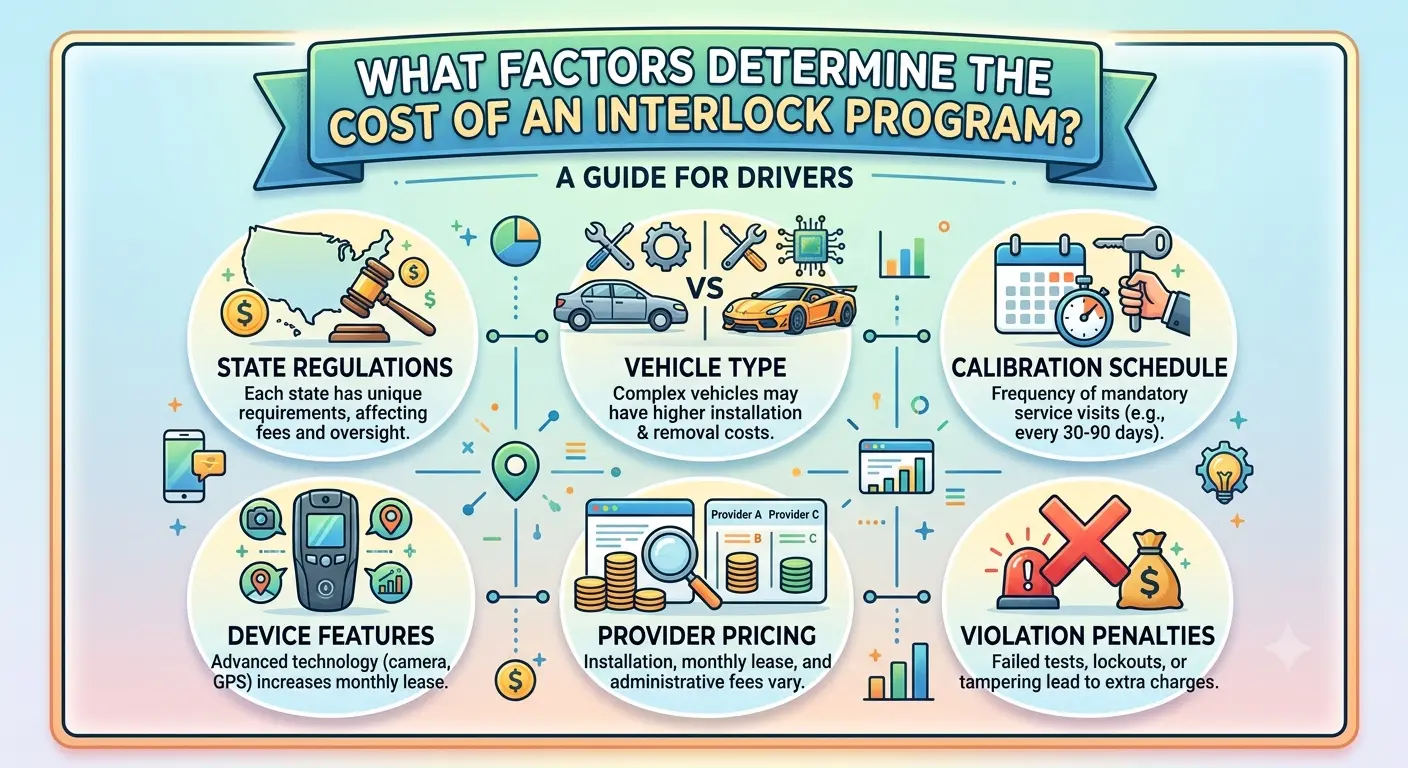

A common misunderstanding about the cost of an ignition interlock is how the costs end up in the end for the program participant. Because so many variables in the program are controlled by the program rules and the participant behavior, the cost of the hardware itself is often not as variable as other parts of the program. Therefore, for those who advise participants, are a monitoring authority for participants with interlocks, or have a compliance budget for a group of participants with interlocks, knowing where the money goes in the end is critical to making an accurate estimate versus a painful shortfall.
Duration is the dominant cost driver
The majority of an interlock program’s cost for interlock service is for the monthly lease and monitoring service. Since most lease terms are for 12 months of service, a device leased for 12 months will generally be twice the cost of a device leased for 6 months. Thus, the factor that determines total cost is the factor that determines the term of service (as opposed to the factor that determines the cost per unit of hardware or service).
Most interlock terms are set based on the underlying offense, prior offenses and blood alcohol content (BAC) at the time of the arrest. Repeat offenders and high BAC offenders typically are required to participate in interlock for 6 months and often up to a year or more. Those who are placed on a restricted or so-called “hardship” license near the beginning of a suspension may have an interlock requirement associated with that license, which would run concurrently with the main suspension term and have a different budget impact than if it were consecutive to the main term.
Extensions triggered by violations
Most jurisdictions lock out the driver for extended periods of time for so-called “violations” including failed rolling retests, tampering, missed service appointments and start attempts over the programmable start allow threshold set by installation staff. Typically these lockouts last anywhere from 30 to 90 days and include full monthly monitoring fee plus cost to reset device for violation and for review of violation by program staff. Thus a person with a term of 6 months can end up paying for 9 to 10 months of service.
Installation and the vehicle itself
All the installation prices are on the hardware. There are big variations in vehicle pricing. Systems that require push-button start, hybrid and electric vehicles, and complex body control systems (such as cars with memory seats etc.) generally require more time to wire up and may need additional relays and wire harnesses. Trucks (such as Renault trucks) and cars with aftermarket alarm systems and remote start systems generally cost more to install because of the amount of time required. Sometimes the remote start has to be disabled on these vehicles.
The cost for each additional vehicle for the participant will multiply the cost for the first vehicle, each additional vehicle will require a separate device, lease, and services to be provided on a regular basis. An employer exemption from the requirement to install an ignition interlock in the vehicle that the participant uses for work may be available where the participant’s employer owns the vehicle. However, such an exemption would require that the appropriate documentation be updated and that the participant or business that the participant is affiliated with not be the owner of the vehicle.
Servicing, calibration, and data reporting
Each service visit (calibration and data download) is typically billed on an ongoing basis every 30-60 days. Participants are expected to make each service visit to continue operating the ignition interlock device. Missed service visits can result in a lockout that requires a tow to a service center for unlocking by a service representative or a call to the service center for clearing of lockout by service representative.
| Cost component | Frequency | What drives it up |
| Installation | Once per vehicle | Push-button start, hybrid systems, aftermarket alarms |
| Monthly lease and monitoring | Every month of term | Term length, violation extensions, multiple vehicles |
| Calibration visit | Every 30 to 60 days | Shorter mandated intervals, missed appointments |
| Camera or GPS module | Added to monthly fee | Program tier, prior offenses, court order terms |
| Removal and reset fees | End of term, or per event | Early removal requests, lockouts, tamper reviews |
Optional and mandated add-ons
Additional services such as cameras, real-time reporting, and GPS tracking are often offered by providers as upgraded tiers of service. However, some programs may mandate these features. It is also important to note that participants will be charged the upgraded tier of service and not receive any additional benefit of being in the higher tier of service than what the ordering authority ordered.
Program requirements that sit outside the device
Most aspects of the interlock condition that parties contract for around the issue of interlock expenditures have their own cost, and their own potential for failure. So for example, reinstatement fees for the client to re-administer to drive, the cost of the program that the client is required to be enrolled in, required education or treatment programs, and the regular reports to the monitoring officer, all of these are costs that are not included in the quotes for the breath test interlock device that are typically sought by individuals and their attorneys. Anyone budgeting for a term in that province should start by reviewing a published fee schedule such as this breakdown of interlock program costs in Ontario, which separates device charges from the administrative items that are easy to overlook.
- State or provincial reinstatement and license reissue fees
- Program administration or enrollment charges levied by the monitoring authority
- Required assessment, education, or treatment programming
- SR-22 or equivalent high-risk insurance filings for the duration of the term
- Removal certification and post-removal license transaction fees
Indigency and fee reduction programs
The majority of jurisdictions within interlock regimes include provisions whereby providers offer interlocks on a sliding scale to individuals below certain income levels. In many instances documentation of public benefit may be required or individuals may need to provide evidence of their status as recipients of federal or state benefits or demonstrate that they fall within specified percentages of the federal poverty guideline. Such provision can reduce the monthly lease fee by as much as half. Interlock regimes of this type are frequently underutilized. There is considerable merit in making provision at the front-end of any interlock program and verifying the existence of eligibility at the outset to obtain the best price for the period of the term.
Building a defensible estimate
- Confirm the ordered term and whether any concurrent requirement applies.
- Count vehicles requiring installation and check employer exemption eligibility.
- Identify the mandated service interval and any required monitoring features.
- Add all non-device program fees, including insurance filings.
- Build in a contingency for one violation-driven extension.
This is the one step that is most often not taken by participants and therefore they run out of money before the end of their interlock term.



