

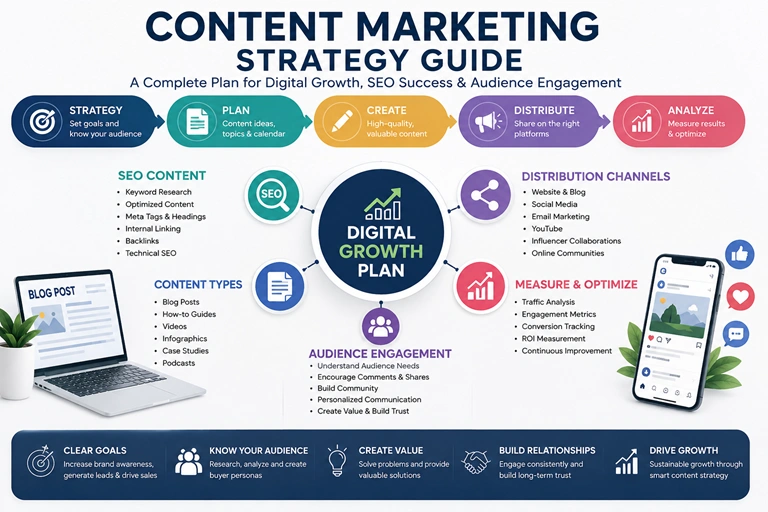

Imagine publishing three detailed blog posts every week, sharing content on social media, sending newsletters and producing videos—yet your website traffic barely moves and sales remain flat. The problem may not be how much content you create. It may be that the content has no clear strategic purpose. A strong content marketing strategy connects audience needs, useful information, search intent, distribution and business goals so every worthwhile piece of content has a job to do.
Quick Summary
- Start with a specific business goal rather than simply deciding to “publish more content.”
- Define your ideal audience and understand the questions, problems and buying concerns they have.
- Build content around search intent and topics where your business can demonstrate genuine expertise.
- Create different content for awareness, consideration and conversion stages.
- Use a consistent publishing and distribution system instead of relying on random posts.
- Measure qualified traffic, engagement, leads and revenue—not pageviews alone.
- Update successful content regularly as information, search behavior and customer expectations change.
What Is a Content Marketing Strategy?
A content marketing strategy is a structured plan for creating, publishing, distributing and improving content to achieve specific business objectives.
Content can include blog articles, landing pages, case studies, newsletters, videos, podcasts, social media posts, comparison guides, tutorials, research reports and downloadable resources. The format matters less than the purpose behind it.
A business selling accounting software, for example, might publish an article explaining how to calculate business expenses. That article can attract people searching for an immediate answer. Another article might compare accounting software options, reaching visitors who are closer to making a purchase. A case study can then demonstrate how an actual customer reduced administrative work after adopting the product.
That is strategy in action.
Without a strategy, content often becomes a collection of disconnected pages. With one, individual pieces support a larger customer journey.
A useful strategy should answer five basic questions:
- Who are we trying to reach?
- What problems or questions do they have?
- What content can we provide that genuinely helps them?
- How will that content reach them?
- What business result should it influence?
The answers become the foundation for your content marketing plan.
Why Does Your Business Need a Content Marketing Strategy?
Creating content requires time, money and expertise. A strategy helps make sure those resources are spent on topics that matter.
One major advantage is compounding value. A social post may generate attention for a short period, while a well-researched evergreen article can continue attracting search visitors months or even years after publication when it remains useful and competitive.
Content can also build trust before a customer ever contacts your business.
Suppose someone is researching home insurance. They may not be ready to request a quote after their first search. They could begin with questions about coverage, deductibles and exclusions. If the same insurance company consistently provides clear, accurate explanations, that company becomes familiar during the research process.
This is particularly valuable for businesses with longer buying cycles.
Content Supports Different Business Goals
Your strategy should connect content to measurable objectives such as:
- Increasing qualified organic traffic
- Generating leads
- Supporting sales conversations
- Building brand awareness
- Educating prospective customers
- Increasing newsletter subscribers
- Improving customer retention
- Reducing repetitive customer-support questions
- Establishing topical authority in a specific subject
The goal is not to make every article sell something directly. Some content attracts new audiences, some builds credibility, and some helps people make a purchase decision.
The important part is knowing which role each piece plays.
How Do You Build a Content Marketing Strategy?
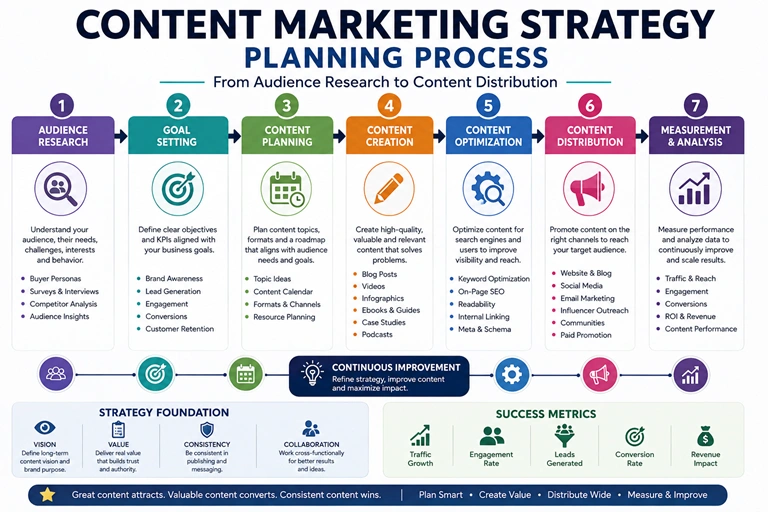
Building a strategy becomes much easier when you work through the process in stages.
1. Start With Business Goals
Do not begin by opening a keyword tool and choosing random topics.
Start with the business.
If your primary objective is lead generation, your content strategy should eventually move readers toward useful conversion points such as consultations, demos, quote requests or sign-ups.
If your priority is brand awareness, broader educational content may deserve more attention.
For an e-commerce business, product comparisons, buying guides and category content may be particularly valuable. A B2B company might prioritize research reports, case studies, expert guides and solution-focused content.
The content strategy should serve the business—not become a separate publishing activity.
2. Define Your Target Audience
“Everyone interested in digital marketing” is not a useful audience definition.
Get more specific.
Consider:
- Industry or profession
- Experience level
- Main challenges
- Budget
- Buying motivation
- Common objections
- Information sources
- Search behavior
- Questions asked before purchasing
You can create simple audience profiles based on real customer conversations, support questions, sales calls, reviews and website analytics.
For example, a website selling project-management software might discover that small agencies are less interested in technical software specifications and more concerned about missed deadlines, client communication and team accountability.
That insight changes the content plan.
Instead of publishing generic “project management tips,” the company could create practical resources around managing agency deadlines, client approvals and distributed creative teams.
3. Research Topics and Search Intent
Keyword research is useful, but keywords alone should not control your strategy.
You need to understand search intent.
A person searching “what is email marketing” has a different need from someone searching “best email marketing software for small business.”
The first query is primarily informational. The second has stronger commercial intent.
A useful content strategy typically covers several types of intent:
Informational: The user wants to learn something.
Commercial: The user is researching products, services or solutions.
Transactional: The user is ready to take action or purchase.
Navigational: The user is looking for a specific website, brand or resource.
Study the pages already ranking for important queries. Look at the format, depth, questions answered and information users appear to need.
Then ask a harder question: Can your content provide something genuinely better, clearer or more useful?
If the answer is no, publishing another generic article may not be the best use of your resources.
4. Build Topic Clusters
Instead of treating every article as an isolated project, organize related content into topic clusters.
For example, a website focused on content marketing might have a central guide about content strategy supported by articles covering:
- Content calendar creation
- Keyword research
- Blog optimization
- Content distribution
- Content repurposing
- SEO writing
- Content performance measurement
- Lead-generation content
These related pages can link naturally to one another.
This structure helps readers discover additional information and gives search engines clearer context about the subjects your website covers.
A strong topic cluster should feel useful to humans first. Do not create dozens of thin pages simply because a keyword spreadsheet says you can.
What Should a Content Marketing Funnel Look Like?
Effective content should meet people at different stages of the buying journey.
Top of Funnel: Awareness
At the awareness stage, people may not fully understand their problem or know your brand.
Useful formats include:
- Beginner guides
- Educational blog posts
- Explainers
- Industry trends
- Research-based articles
- Videos
- Checklists
For example, a cybersecurity company could publish “How to Recognize a Phishing Email” for people who are learning about online security.
Middle of Funnel: Consideration
Now the audience understands the problem and is evaluating possible solutions.
This is where content can become more specific.
Useful formats include:
- Product comparisons
- Detailed tutorials
- Case studies
- Expert guides
- Webinars
- Implementation resources
- Buyer guides
A visitor comparing different solutions may need evidence, examples and practical criteria rather than another basic definition.
Bottom of Funnel: Conversion
At this stage, the user is closer to taking action.
Useful content includes:
- Product pages
- Service pages
- Pricing explanations
- Demonstrations
- Customer stories
- Free consultations
- Trials
- Detailed comparison pages
The content should make the next step obvious without becoming overly aggressive.
Good conversion content answers the questions that could prevent someone from moving forward.
How Do You Create Content That Performs in Search?
Modern SEO content needs more than a keyword repeated in strategic locations.
Start with the searcher’s actual problem.
If someone searches for “how to create a content calendar,” they probably want a process, examples and a practical template—not 1,500 words explaining the history of calendars.
Structure the article so readers can quickly find what they need.
Use descriptive headings, short paragraphs, relevant examples, useful tables where appropriate and direct answers to common questions.
Demonstrate First-Hand Expertise
This is one area where generic content often falls short.
Include practical observations, original examples, processes, screenshots where appropriate, data you can verify and lessons from actual experience.
If you are writing about email marketing, don’t simply say that subject lines matter. Explain what makes a subject line useful, show examples and discuss situations where different approaches make sense.
If you publish original research, clearly explain the methodology.
Trust grows when readers can see how conclusions were reached.
Optimize for People Using AI Search and Voice Search
Answer-focused formatting can make content easier for both people and modern search interfaces to understand.
Question-based headings can work well when they match genuine user queries:
What is a content marketing strategy?
How do you create a content marketing plan?
How often should you publish content?
Give the direct answer near the beginning of the relevant section, then provide supporting detail.
This does not mean writing unnaturally for search engines. It means making important information easy to identify, understand and verify.
How Should You Distribute Your Content?
Publishing an article is not the end of the process.
A useful piece of content can be adapted into several formats.
One detailed guide could become:
- A LinkedIn post
- Several short social posts
- An email newsletter
- A short video
- A carousel
- A podcast discussion
- A downloadable checklist
- Internal sales material
This approach is often called content repurposing.
Distribution should also match the audience. A B2B company may gain more value from LinkedIn, email and industry publications than from trying to maintain a presence on every social network.
Likewise, a visually driven consumer brand may need a different distribution mix.
Do not chase every platform. Concentrate on channels where your audience actually spends time.
How Do You Measure Content Marketing Success?
One of the biggest mistakes in content marketing is treating traffic as the final objective.
Traffic matters, but 100,000 visitors who never become customers may be less valuable than 5,000 highly relevant visitors who generate qualified leads.
Track metrics according to the original business goal.
Useful Content Metrics
Awareness: impressions, organic visibility, new users and branded searches.
Engagement: engaged sessions, returning visitors, scroll behavior and newsletter interaction.
Conversion: leads, sign-ups, demo requests, quote requests and sales.
Business impact: revenue influenced by content, customer acquisition efficiency and assisted conversions.
Look for patterns rather than obsessing over one number.
An article that receives modest traffic but consistently generates qualified leads may be far more valuable than a high-traffic article that attracts visitors with no connection to your product.
Build a Simple Content Scorecard
For each important content asset, record:
| Metric | What It Tells You |
|---|---|
| Organic traffic | Whether search visibility is growing |
| Engagement | Whether visitors find the page useful |
| Conversions | Whether content contributes to business goals |
| Backlinks | Whether other sites find it valuable |
| Rankings | How well it competes for target queries |
| Updates needed | Whether information has become outdated |
Review this data periodically rather than making decisions based on a single week’s performance.
Common Content Marketing Mistakes to Avoid
Even businesses with good writers can struggle when the strategy is weak.
Publishing Without a Clear Audience
If an article could be written for absolutely anyone, it may not be useful enough for anyone.
Chasing Only High-Volume Keywords
High search volume can look attractive in a spreadsheet. Competition, intent and business relevance matter just as much.
A smaller keyword with strong commercial intent may deliver better results.
Creating Content Only When Inspiration Strikes
Consistency does not mean publishing every day. It means having a repeatable system.
A realistic schedule of two excellent articles per month can outperform a rushed daily publishing routine.
Ignoring Existing Content
Before creating something new, review what you already have.
Some older pages may be close to ranking well and need better examples, updated information, stronger internal links or improved search intent alignment.
Updating a useful existing resource can sometimes be more efficient than starting from zero.
Making Every Article a Sales Pitch
Readers notice.
Educational content should educate. Comparison content should compare fairly. Product content should explain the product clearly.
Trust disappears when every paragraph sounds like an advertisement.
How Often Should You Publish Content?
There is no universal number that guarantees success.
The better question is: How much high-quality content can your team consistently produce and maintain?
For a small business, one deeply researched article every two weeks may be perfectly reasonable. A larger organization with dedicated writers, editors and subject-matter experts can publish much more.
Quality includes accuracy, usefulness, originality, clear writing and ongoing maintenance.
A practical publishing system might include:
Week 1: Research and outline.
Week 2: Write and edit.
Week 3: Publish, internally link and distribute.
Week 4: Review performance and identify updates.
Then repeat.
The exact schedule can change, but the system keeps content creation from becoming chaotic.
Frequently Asked Questions
What is a content marketing strategy?
A content marketing strategy is a plan for creating, publishing, distributing and improving content to attract a specific audience and support measurable business goals such as traffic, leads, sales, trust or customer retention.
How do I create a content marketing plan?
Start by defining business goals and your target audience. Research customer questions and search intent, organize topics into clusters, choose appropriate content formats, create a publishing schedule, distribute the content and measure results against your goals.
Is content marketing good for SEO?
Yes. Useful, well-structured content can help a website earn relevant search visibility, attract qualified visitors and build topical authority. SEO results depend on content quality, competition, technical health, authority and how well the page satisfies search intent.
How long does content marketing take to produce results?
Results vary by website, industry, competition and content quality. Some pages can attract search traffic relatively quickly, while competitive topics may require months of consistent publishing, optimization, internal linking and authority building before significant growth appears.
Conclusion
A successful content marketing strategy is not a race to publish the largest number of articles. It is a system for consistently answering the right questions for the right audience while supporting real business objectives.
Start with customer problems. Match content to search intent and buying stages. Create fewer pieces when necessary, but make them genuinely useful. Then distribute, measure and improve what you publish.
The strongest content programs are rarely built around one viral article. They grow through a collection of helpful resources that earn attention, build trust and make the next customer decision easier.