

Why Gamified Learning Apps Are So Popular in 2026
You open an app intending to practice for five minutes. Twenty minutes later, you’re still going because you’ve nearly completed a level, beaten yesterday’s score, or unlocked the next challenge. That is the appeal behind the best apps for learning new skills in 2026: they don’t rely on motivation alone. They build small goals, feedback, progress and rewards into the learning experience so practicing feels more like doing something than enduring something.
But there is a catch. A colorful interface does not automatically make an app educational. The strongest platforms connect game mechanics to actual practice, retrieval, problem-solving or performance. The ten apps below stand out because they use gamification in noticeably different ways.
Quick Summary
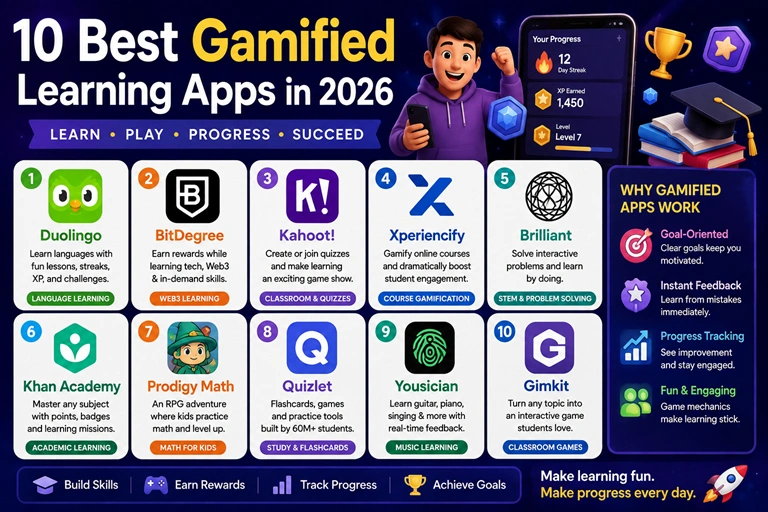
- Duolingo is the strongest all-round choice for language learning.
- BitDegree is unusual because its gamification is closely tied to Web3 and reward-based Missions.
- Kahoot! is excellent for interactive quizzes, classrooms and group learning.
- Xperiencify is aimed at course creators who want to make online courses more engaging.
- Brilliant focuses on interactive problem-solving rather than passive video lessons.
- Khan Academy adds points, badges and progress mechanics to a broad free education platform.
- Prodigy Math turns elementary and middle-school math practice into an RPG-style experience.
- Quizlet combines flashcards, practice and games with a huge user-created study library.
- Yousician uses audio recognition to give real-time feedback while people play instruments or sing.
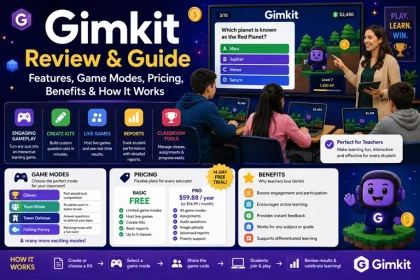
- Gimkit turns classroom question sets into live educational games.
The important distinction is that these are not ten versions of the same product. Some are designed for individuals, some for classrooms, some for children, and one is primarily a platform for course creators.
1. Duolingo: The Gold Standard of Gamified Learning
If someone asked for one example of gamification done exceptionally well, Duolingo would be an obvious answer.
Its core strength is simplicity. A learner completes a short lesson, receives immediate feedback, earns XP, maintains a streak and works toward another small objective. Duolingo says its courses combine gamification with learning science, and its platform includes XP, leaderboards, streaks, challenges and other motivational mechanics.
The clever part isn’t any individual feature. It’s the feedback loop.
Practice → feedback → progress → reward → another practice session.
That loop reduces the psychological weight of starting a study session. You don’t need to think, “I have to study Spanish for an hour.” You can simply complete the next lesson.
Duolingo also continues to expand beyond traditional language exercises. Its Adventures feature, for example, puts learners into video-game-like scenarios such as ordering food or asking for directions while practicing conversational skills.
Best for: Languages and consistent daily practice
Gamification strength: Streaks, XP, leagues, challenges and progression
Potential weakness: Gamification can make progress feel more important than deeper study if used without additional practice.
2. BitDegree: The Earn-to-Learn Platform
BitDegree takes gamified learning in a very different direction.
Rather than simply awarding virtual points, its current platform focuses heavily on Web3 learning, Missions and real-world rewards. Learners complete micro-tasks, quizzes and other activities, earn Bits and may receive rewards such as tokens, airdrops, NFTs or other prizes depending on the Mission.
BitDegree has also explicitly connected its gamification approach to Yu-kai Chou’s Octalysis Framework, which examines different human motivational drivers behind engaging experiences.
That makes BitDegree interesting for people learning crypto, blockchain and Web3 concepts who enjoy external incentives.
It is worth making one distinction, though: this isn’t the general-purpose alternative to Duolingo or Khan Academy that its “learning app” label might suggest. Its current focus is much more specialized.
Best for: Web3, crypto and reward-based learning
Gamification strength: Missions, points and external rewards
Potential weakness: Its subject focus is narrower than most apps on this list.
3. Kahoot!: Turning Classrooms Into Game Shows
Kahoot! is particularly strong when learning happens with other people.
A teacher can host a live quiz while students answer from their own devices. The familiar combination of questions, scores, rankings and quick feedback creates an atmosphere that can feel surprisingly close to a game show.
But Kahoot! has become broader than the classic live quiz format. Its current game experiences include Classic, Accuracy, Confidence, Team and several themed modes. Kahoot! also offers self-study tools such as Flashcards, Learn, Test and Study Groups.
That distinction matters.
A platform that only works when a teacher is standing in front of a classroom has limited usefulness for independent learners. Kahoot! now supports both group experiences and self-paced study.
Its 2026 updates also include AI-assisted content creation, confidence-based gameplay and additional interactive learning experiences, although feature availability varies by plan.
Best for: Classrooms, revision and group quizzes
Gamification strength: Competition, teamwork, game modes and instant feedback
Potential weakness: The competitive format isn’t ideal for every learner or every lesson.
4. Xperiencify: Course Completion as a Game
Xperiencify is the odd one out in this list because it is primarily a gamified course platform, rather than a conventional consumer learning app.
Its pitch is straightforward: course creators already have educational content, but students often don’t finish it. Xperiencify adds points, rewards, triggers, missions, progress experiences and other gamification mechanisms around that content.
The company says it developed its approach after seeing low completion rates in traditional online courses. In its own case study, Xperiencify says its completion rate increased from around 5% to more than 50% after applying gamification and learning-psychology techniques. Those are company-reported results, so they should be treated as an internal case study rather than a universal benchmark.
Its current tools include an Experience Engine, XP systems, rewards, course-completion experiences and automated actions.
Best for: Course creators, coaches and online educators
Gamification strength: Deep course-level progression and automated rewards
Potential weakness: It’s overkill if you simply want to learn a language or memorize vocabulary.
5. Brilliant: Where You Learn by Doing
Brilliant takes a different philosophical approach: don’t just watch someone solve the problem—solve it yourself.
The platform focuses on interactive STEM learning across areas such as mathematics, computer science, science, data analysis and AI. Instead of relying primarily on long lectures, Brilliant presents interactive problems and gives feedback while the learner works through them.
Its gamification is more subtle than Duolingo’s. There are streaks, daily goals, progress tracking and competitive elements, but the central experience remains solving problems.
That is a major strength.
If you’re trying to learn algebra, probability or programming, collecting badges isn’t enough. You need to manipulate the concept, make mistakes and correct your thinking. Brilliant puts that activity at the center.
The platform currently says it has more than 60 interactive courses and offers a free tier with up to two lessons per day, while Premium provides broader access and additional features.
Best for: Math, science, coding and analytical thinking
Gamification strength: Streaks, progress, challenges and bite-sized goals
Potential weakness: It is less useful if your target skill is outside its STEM-heavy curriculum.
6. Khan Academy: When Learning Feels Like a Mission
Khan Academy proves that gamification doesn’t need flashy graphics.
Its primary educational model is still structured instruction and practice, but the platform includes game-like progression through energy points, badges and avatars. Khan Academy explicitly describes energy points as a measure of effort rather than mastery or ability.
That distinction is healthy.
A learner can earn points for completing activities, but points aren’t presented as proof that someone has mastered a subject. Badges can recognize behaviors such as completing skills, watching content or reaching learning milestones.
The result is a quieter form of gamification. You are encouraged to keep going, but the learning remains the main event.
For students who need mathematics, science, economics, computing and other academic subjects, this makes Khan Academy one of the strongest free options available.
Best for: Academic learning and foundational skills
Gamification strength: Points, badges, avatars and progress
Potential weakness: It doesn’t feel as game-like as Prodigy or Gimkit.
7. Prodigy Math: The RPG Where Kids Learn Math
Prodigy is perhaps the clearest example of hiding practice inside an actual game structure.
Students create a character and enter an RPG-style world. Math questions are integrated into gameplay, so answering correctly helps the character progress, battle opponents and develop abilities. Prodigy’s documentation describes the experience as a curriculum-aligned adaptive game with thousands of math questions for Grades 1–8.
That makes a difference for younger learners.
A child who would resist a page of multiplication problems may happily spend time playing a wizard who happens to encounter multiplication problems while exploring a virtual world.
Prodigy has also expanded its math practice experiences. Its 2026 Math Facts feature uses short game-based activities to build arithmetic fluency while hiding timers from students, with teachers receiving customization and progress tools.
Best for: Children learning elementary and middle-school math
Gamification strength: RPG progression, characters, quests and rewards
Potential weakness: Older learners may find the presentation too child-focused.
8. Quizlet: The Study Tool Built Around Practice
Quizlet is not a pure gamification app, and that’s precisely why it belongs here.
Its foundation is study material—especially flashcards—but it adds interactive modes, practice tests and games to make repetition less tedious. Quizlet says more than 60 million learners use the platform and that its library contains more than 900 million study sets.
That huge content ecosystem is one of its biggest advantages.
You can create your own study set or find material created by someone else. Then you can move between different modes depending on what you need: memorization, recall, practice testing or review.
The gamification isn’t as theatrical as Prodigy. Instead, Quizlet makes the repetitive part of studying easier to tolerate.
And sometimes that’s exactly what a good learning app should do.
Best for: Vocabulary, exam preparation, memorization and review
Gamification strength: Interactive study modes and game-style practice
Potential weakness: The quality of user-created material can vary, so students should check sources carefully.
9. Yousician: Real Instruments, Real-Time Feedback
Yousician stands apart because you need to do something physical.
You don’t simply tap an answer. You pick up a guitar, bass, ukulele, piano or use your voice—and the app listens.
Yousician’s audio-recognition technology provides real-time feedback while you play, helping learners see whether notes, chords, timing and accuracy are on track. Its current platform supports guitar, bass, ukulele, piano and singing, with guided lessons, exercises and songs.
This is gamification with consequences.
If you miss a note, the app knows. If you improve, your performance improves. The feedback loop connects the digital reward system to an actual physical skill.
Its guitar learning experience also includes guided paths, daily exercises, progress tracking and a large library of lessons and songs.
Best for: Guitar, piano, singing, bass and ukulele
Gamification strength: Scores, progress, challenges and immediate performance feedback
Potential weakness: No app can completely replace an experienced human music teacher, especially for advanced technique.
10. Gimkit: Educational Games That Keep Students Moving
Gimkit is built primarily for classroom learning.
Teachers create question sets called Kits, choose a game mode and host a live session. Students answer academic questions while interacting with game mechanics such as rewards, progress and competition.
That makes Gimkit particularly useful for review sessions. A teacher can take a set of questions about a science chapter, vocabulary unit or math topic and turn it into a more energetic classroom activity.
The strength here isn’t simply that students are playing. It’s that the questions remain the engine of the game.
This is an important distinction when evaluating educational gamification. If students can succeed without engaging with the learning objective, the game may be entertaining but educationally weak.
Gimkit’s model works best when the teacher carefully designs the Kit, selects a suitable game mode and uses the resulting performance as formative feedback.
Best for: Teachers, students, classroom review and interactive quizzes
Gamification strength: Live competition, rewards, game modes and classroom interaction
Potential weakness: Its value depends heavily on the quality of the teacher-created questions and the fit between game mode and lesson.
What Makes These Apps Work—and Why Most Gamified Learning Apps Fail
Gamification is often misunderstood as “add points and badges.”
That’s the easy part.
The harder question is: What behavior are those points encouraging?
The strongest apps on this list use game mechanics to reinforce useful learning behaviors.
1. They Make Progress Visible
A progress bar, streak, level or completed path answers a simple psychological question:
Am I getting somewhere?
Duolingo’s streaks, Brilliant’s progress system, Khan Academy’s badges and Yousician’s skill progression all give learners a visible sense of movement.
Without that signal, learning can feel endless.
2. They Keep Tasks Small
A two-hour study session sounds difficult.
A ten-minute lesson doesn’t.
Many successful learning apps break a large skill into small activities. Brilliant recommends short daily sessions, while Duolingo’s lessons are deliberately structured around manageable chunks.
Small tasks reduce the friction of starting.
3. They Give Immediate Feedback
Feedback is especially powerful when learning a practical skill.
Yousician can respond to the sound of your playing. A math game can tell you whether an answer is correct. A language app can immediately flag a mistake.
That short feedback loop helps learners adjust before the mistake becomes a habit.
4. They Create Meaningful Challenges
A good game doesn’t make everything easy.
If every answer earns the same reward and every level can be completed without effort, the experience quickly becomes boring.
The better platforms gradually increase difficulty or introduce new challenges. Prodigy’s adaptive approach, for example, can move students forward when they’re doing well or return to prerequisite skills when they struggle.
5. They Reward the Right Behavior
This is where many gamified apps get things wrong.
If a leaderboard rewards speed, students may rush. If a streak becomes more important than understanding, learners may complete the easiest possible activity just to preserve the streak.
Kahoot!’s current Accuracy mode is an interesting response to this problem because it emphasizes correct answers rather than speed. Its Confidence mode also asks learners to consider how certain they are about their answers.
Good gamification should reinforce the behavior that actually leads to learning.
6. They Don’t Confuse Engagement With Mastery
This may be the biggest lesson from the entire list.
A learner can spend 100 hours inside an app and still fail to develop the underlying skill.
Engagement is useful because it creates more opportunities to practice. It is not the same thing as competence.
That is why Brilliant’s problem-solving approach, Yousician’s performance feedback, Khan Academy’s mastery-oriented practice and Prodigy’s curriculum-aligned questions matter. The game layer has to connect to something educational underneath it.
Which Gamified Learning App Should You Choose?\

There isn’t one winner for everyone.
| Goal | Best Choice |
|---|---|
| Learn a language | Duolingo |
| Learn Web3/crypto | BitDegree |
| Classroom quizzes | Kahoot! |
| Gamify your own online course | Xperiencify |
| Learn math, science or coding interactively | Brilliant |
| Free academic learning | Khan Academy |
| Math for younger students | Prodigy Math |
| Flashcards and exam review | Quizlet |
| Learn a musical instrument | Yousician |
| Classroom game-based review | Gimkit |
The right choice comes down to the skill itself.
If you’re learning Spanish, you need repeated language exposure. If you’re learning guitar, you need to physically play. If you’re learning calculus, you need to solve problems. If you’re reviewing a history exam, retrieval practice may be the priority.
The best app is the one whose game mechanics encourage the behavior your skill actually requires.
Frequently Asked Questions
What are the best gamified learning apps in 2026?
The best options depend on the skill. Duolingo is excellent for languages, Brilliant for interactive STEM learning, Yousician for music, Prodigy for children’s math, Quizlet for study and review, and Kahoot! and Gimkit for classroom learning.
Does gamification actually help people learn?
Gamification can make practice more engaging and encourage learners to return, but rewards alone do not guarantee mastery. The strongest apps connect points, challenges and progression to useful behaviors such as retrieval, problem-solving, repetition or real-world performance.
Which learning app is best for students?
For academic students, Khan Academy, Brilliant, Quizlet, Prodigy, Kahoot! and Gimkit each serve different needs. Younger math learners may prefer Prodigy, while older students preparing for exams may get more value from Quizlet or Brilliant.
What is the best app for learning a practical skill?
Yousician is a strong example because learners practice a real instrument while the app listens and provides immediate feedback. For languages, Duolingo is a natural choice; for STEM problem-solving, Brilliant is better suited.
Final Verdict
The most effective gamified learning apps don’t try to turn education into an endless video game. They borrow the parts of games that help people keep going—clear goals, visible progress, manageable challenges, feedback, rewards and a reason to return—then connect those mechanics to genuine practice.
That’s why this list is deliberately varied. Duolingo excels at habit-building, Brilliant at active problem-solving, Yousician at real-world performance, Khan Academy at accessible academic learning, and Kahoot! and Gimkit at social classroom engagement. Quizlet makes repetition easier, Prodigy wraps math in an RPG, BitDegree experiments with reward-driven Web3 learning, and Xperiencify applies gamification to complete online courses.
If you are choosing one today, don’t ask which app has the most badges.
Ask a better question:
Which app makes me practice the skill I actually want to improve?
That is the difference between an app that is merely fun and one that can genuinely help you get better.