

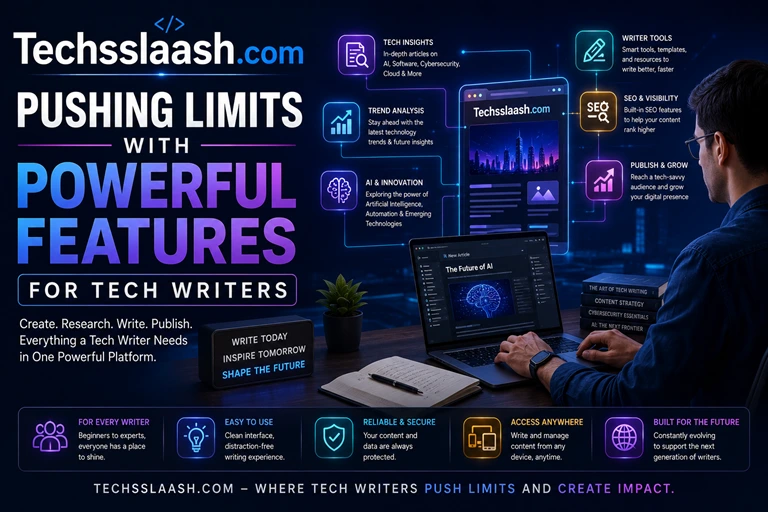

Technology writers have a difficult job in 2026. The industry moves quickly, terminology changes almost overnight, and readers expect more than recycled announcements. A good technology article has to explain what a product does, why it matters, where it fits into a wider trend and sometimes what could go wrong. Techsslaash.com is built around this fast-moving technology environment, bringing together subjects such as artificial intelligence, software, cybersecurity, cloud computing and emerging digital innovations.
Quick Summary
- Techsslaash.com focuses on technology-related topics designed for readers interested in digital innovation.
- Its subject areas can be useful for writers researching AI, software, cybersecurity, cloud technology and emerging trends.
- Technology writers can use structured explanations and trend coverage as starting points for deeper research.
- AI is changing both the subjects technology writers cover and the way digital content is researched and produced.
- Strong tech writing still requires fact-checking, original perspective, clear explanations and responsible use of AI.
- The most useful technology content connects technical developments with practical consequences for real users.
What Is Techsslaash.com and Why Does It Matter to Tech Writers?
A technology publication lives in a strange environment. There is never a shortage of information, but there is often a shortage of clarity.
A developer might understand an AI architecture but struggle to explain it to a business owner. A business reader may understand the commercial value of automation but have little interest in the technical details behind a model. A technology writer sits somewhere between those audiences, translating complicated ideas into language that people can actually use.
That makes a technology-focused platform valuable as a research and inspiration resource.
Techsslaash.com covers a broad range of technology subjects, including artificial intelligence, software development, cybersecurity and cloud computing. Its technology-oriented coverage also extends into areas such as AI-powered search, AI applications and agentic AI.
For tech writers, that broad subject range creates opportunities to explore connections between different parts of the industry. AI is no longer an isolated topic, for example. It intersects with search, cybersecurity, software engineering, productivity and business automation.
The challenge for writers is keeping those connections understandable.
A strong article shouldn’t simply tell readers that a new technology exists. It should answer the obvious follow-up questions: What does it do? Who is it for? What problem does it solve? What are its limitations? And what should readers do with this information?
That is where thoughtful technology writing earns its value.
How Can Techsslaash.com Help Writers Follow Fast-Moving Technology?
Technology writers constantly need fresh angles.
One day the assignment might be about an AI assistant. The next could involve cloud computing, cybersecurity or an emerging software development approach. The subject changes, but the research process has a familiar foundation: understand the technology, identify its practical relevance and communicate it without unnecessary jargon.
AI and Emerging Technology Coverage
Artificial intelligence is arguably the biggest technology-writing opportunity of the current period.
But simply writing another article titled “What Is AI?” is rarely enough anymore. Readers increasingly want specific explanations.
For example:
- How does agentic AI differ from a chatbot?
- What does AI-powered search actually change?
- How can businesses use AI without exposing sensitive information?
- What are the limitations of AI-generated content?
- Which tasks should remain under human supervision?
- How is AI changing software development?
These questions produce stronger articles because they address user intent rather than merely describing a buzzword.
Techsslaash.com’s technology focus gives writers a useful environment for exploring these subjects and identifying related themes that can become separate articles, explainers, comparisons and practical guides.
Software and Developer Topics
Software development is another area where technology writing benefits from precision.
A writer covering a new development framework, AI coding assistant or programming tool needs to distinguish between marketing language and practical capability. A product might promise increased productivity, but readers will want to know how that improvement is achieved.
Does the tool generate code?
Does it debug existing code?
Can it understand an entire repository?
Does it integrate with popular development environments?
What happens when its suggestions are wrong?
Those are the questions that turn a generic software article into useful technical content.
What Makes a Powerful Tech-Writing Resource?
The phrase “powerful features” should not mean simply having a long list of categories. For technology writers, usefulness comes from how information can be turned into better research and better storytelling.
1. Broad Technology Coverage
A writer benefits from being able to move between related technology subjects.
AI may lead to cybersecurity. Cybersecurity may lead to cloud infrastructure. Cloud infrastructure may lead to edge computing. A discussion about edge computing may eventually connect to IoT or robotics.
The technology industry is interconnected.
A broad publication allows writers to spot these relationships and develop content clusters rather than treating every article as an isolated assignment.
2. Accessible Explanations
Technical writing does not have to be difficult to understand.
In fact, some of the strongest technology articles are technically accurate while remaining accessible to non-specialists.
Imagine explaining an AI agent to someone who has never worked with machine learning. Instead of starting with a dense discussion of architectures and orchestration frameworks, a writer could begin with a familiar example:
A chatbot answers a question. An AI agent may be designed to take a goal and perform several connected actions to accomplish it.
That simple distinction provides a foundation for introducing more technical details later.
3. Practical Context
Readers want to know what technology means for them.
A cloud-computing article becomes more useful when it explains why companies move workloads to the cloud. A cybersecurity article becomes stronger when it shows how a phishing attack could affect an employee. An AI article becomes more useful when it explains a real workflow instead of repeating product marketing.
This practical approach is particularly important for tech writers targeting business and general audiences.
How Is AI Changing the Work of Tech Writers?
There is an interesting irony in covering artificial intelligence while working in a profession that AI itself is changing.
AI can now help writers brainstorm topics, summarize documents, create outlines, rewrite passages and generate first drafts. That can speed up parts of the editorial workflow.
But speed is not the same thing as quality.
A generated paragraph may sound confident while containing an incorrect date, invented statistic or unsupported product claim. Technology writing is especially vulnerable because product specifications, pricing, software versions and technical capabilities change rapidly.
AI Should Assist, Not Replace Editorial Judgment
A sensible technology-writing workflow might look like this:
Research → Verify → Outline → Draft → Fact-check → Edit → Add Original Perspective
AI can be useful at several stages, particularly for brainstorming and organization. The writer remains responsible for determining whether information is accurate and whether the final article genuinely helps the reader.
That distinction becomes increasingly important as search engines and AI systems become better at identifying useful, original content.
Original Experience Still Matters
Suppose two articles explain the same productivity application.
The first repeats the manufacturer’s feature list.
The second explains three realistic workflows, discusses where the application works well, points out limitations and compares the experience with alternatives.
The second article has considerably more editorial value.
Technology writers should therefore add observations, examples, context and analysis wherever they can support them.
Which Technology Topics Are Worth Watching in 2026?
For writers looking for future article ideas, several areas deserve continued attention.
Agentic AI
AI systems are increasingly being discussed in terms of their ability to perform multi-step tasks rather than simply generate responses.
This creates plenty of opportunities for explanatory content: agent orchestration, AI workflows, permissions, reliability, security and human oversight.
AI-Powered Search
Search is changing from a simple query-and-results model toward more conversational experiences.
For writers, this creates an important lesson: articles need to provide clear answers while still offering enough depth and context to be genuinely useful.
Cybersecurity
As organizations adopt AI and cloud technologies, cybersecurity remains a major technology topic.
Writers can explore phishing, identity security, AI security, data protection, zero-trust approaches, cloud security and emerging threats.
Robotics and Physical AI
AI is increasingly moving beyond screens.
Robotics, autonomous systems and intelligent machines introduce a different set of questions around physical safety, reliability and real-world decision-making.
Quantum Computing
Quantum technology remains an emerging area, but it has implications for computing, research and cybersecurity. Writers should be careful to distinguish demonstrated capabilities from long-term predictions.
How Can Tech Writers Create Better Content With Techsslaash.com?
The strongest approach is not to use a technology website as the final authority for every claim. Instead, treat technology coverage as one part of a wider research process.
Start by identifying the topic.
Then ask what the reader actually wants to know.
If the subject is an AI application, readers might need features, use cases, limitations, pricing and privacy considerations.
If the topic is a technology trend, they may want to know whether it is already being used commercially or remains experimental.
If the article concerns cybersecurity, readers need practical recommendations rather than fear-based headlines.
Build Content Around Questions
Question-based research is particularly effective for modern search and answer-engine optimization.
Instead of creating an article around the keyword “AI agents,” consider questions such as:
- What are AI agents?
- How are AI agents different from chatbots?
- What can AI agents actually do?
- Are AI agents safe?
- Which businesses can benefit from AI agents?
- What are the limitations of autonomous AI systems?
Those questions can naturally become headings throughout an article.
The result is usually easier to read and more useful than a page created around repeated keyword variations.
Why Human Expertise Still Matters in Technology Writing
Technology can be measured in benchmarks, specifications and technical documentation, but readers experience it differently.
A new application might have excellent specifications and still be frustrating to use. A sophisticated AI model might be powerful but unsuitable for a company’s privacy requirements. A feature described as “automated” may still require considerable human supervision.
Human judgment helps bridge that gap.
A good technology writer asks uncomfortable questions. What happens when the system fails? Who owns the data? Is the advertised capability available to everyone? Does the product work as well outside a controlled demonstration?
Those questions make content more trustworthy.
For Techsslaash.com and similar technology publications, this approach can help separate useful editorial material from content that merely repeats promotional messaging.
Frequently Asked Questions
What is Techsslaash.com?
Techsslaash.com is a technology-focused website covering subjects such as artificial intelligence, software, cybersecurity, cloud computing and emerging digital technologies. It can serve as a source of technology-related information and topic ideas.
Is Techsslaash.com useful for tech writers?
It can be useful for writers researching technology topics, discovering potential article ideas and understanding broad developments across AI, software and digital innovation. Important factual claims should still be independently verified.
What topics should technology writers cover in 2026?
Strong areas include agentic AI, AI-powered search, cybersecurity, AI software development, cloud technology, robotics, spatial computing, quantum technology and the practical impact of emerging technologies.
Can AI replace technology writers?
AI can automate parts of research, drafting and editing, but strong technology writing still requires judgment, verification, original analysis and audience understanding. Human oversight remains especially important for technical and fast-changing subjects.
Final Thoughts
Techsslaash.com – pushing limits with powerful features for tech writers is ultimately about more than following the latest technology headline. The real opportunity lies in connecting developments to practical questions that readers care about.
Technology writers have an increasingly important role as AI, software, cybersecurity and emerging computing technologies become part of everyday life. The best writers are not necessarily the ones who know every technical term. They are the ones who can take a complicated development, investigate it carefully and explain why it matters.
For anyone building technology content in 2026, that is the standard worth aiming for: accurate research, clear explanations, original perspective and genuinely useful information.